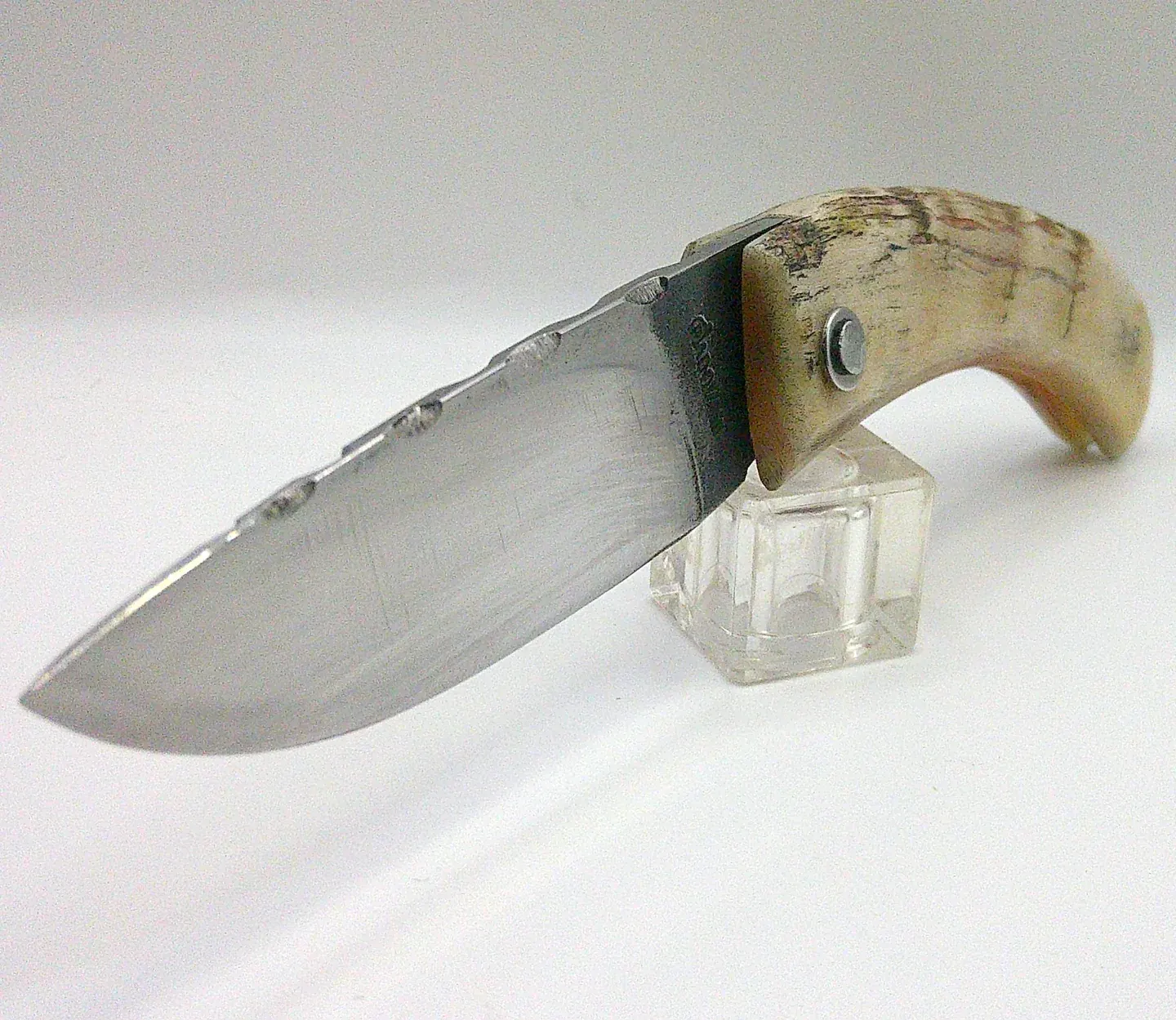
There are objects that sometimes say more about a society than long speeches. Modest objects, designed to fulfill a specific function, that we use without even thinking about it. The Corsican knife belongs to this family.
Before becoming a sought-after piece of cutlery, sometimes collected, it was primarily a working tool. A familiar object, present in rural life, as natural in a pocket as the other tools necessary for the day.
To understand what a truly artisanal Corsican knife is, one must look beyond its shape, handle, or the quality of its steel. One must be interested in the way people lived, worked, and used objects in Corsica.
A culture in which every object had to have its utility
Rural Corsica was long organized around agriculture, livestock, and the activities that stemmed from it. In this world, objects were not chosen for their appearance. They had to first meet a need.
The shepherd, the farmer, the craftsman, or the simple inhabitant of the countryside had tools suited to their occupations. Some were specialized, while others could serve multiple functions.
The knife belonged to this second category.
It could be used to cut food, work with a soft material, prepare small elements of basketry, or accomplish various manual tasks. Its versatility explained its presence in very diverse activities.
This reality is notably documented by the research from the University of Corsica on horn and its artisanal uses. The traditional shepherd's knife appears there as an object linked to the daily needs of farmers and shepherds.
What mattered then was not to possess a spectacular knife, but to have a reliable tool.

The Corsican peasant knife: a function before a name
We often speak of the Corsican shepherd's knife. Less often of the Corsican peasant's knife. Yet, this second expression reminds us of a reality: the knife was not reserved for a profession.
It accompanied a way of life.
In the countryside, the same people could be called upon to cultivate the land, maintain a property, care for animals, or perform domestic work.
The knife had to be able to follow these activities without imposing unnecessary constraints.
Its simplicity was therefore a quality. A blade sufficiently robust, a handle providing a good grip, and maintenance achievable with ordinary means, met very concrete requirements.
However, it would be inaccurate to imagine a single model used throughout Corsica. The shapes, dimensions, and materials have varied according to the productions and needs.
The Corsican peasant knife thus denotes more of a relationship to the object and its use than a precisely defined knife form.
The Corsican shepherd knife: understanding the work rather than the folklore
The Corsican shepherd is an important figure in the insular history, but his existence is not limited to a silhouette in a mountainous landscape.
The Museum of Corsica in Corte provides a much more concrete vision of this.
In 1973, Father Louis Doazan undertook an investigation into goatherd shepherds who still practiced transhumance between the Filosorma, the Marzulinu, and the Niolu. His observations documented the tools, installations, and transformations of a profession.
They remind us that pastoral daily life required multiple skills, precise organization, and a constant ability to adapt.
In this context, the Corsican shepherd knife was primarily a tool among others. It had to be useful, withstand repeated uses, and be maintainable.
The University of Corsica documents in particular the use of traditional knives for certain operations related to animal work and basketry.
It is not a matter of claiming that a single knife performed all the tasks, but rather understanding why a versatile tool could be so valuable.
It is this practical dimension that gives the shepherd knife its true cultural interest.
Why does the Corsican folding knife respond so well to these uses?
A knife intended to accompany its owner must be easily transportable.
This is one of the essential interests of the Corsican folding knife.
Once closed, its blade fits into the handle. The whole becomes more compact and more convenient to carry than a fixed-blade knife of comparable dimensions.
This design is particularly suitable for a knife that one wishes to keep on hand for small everyday tasks.
One must also distinguish between the different mechanisms.
Not all folding knives have a locking mechanism. Some rely on friction or a spring, while others use a blade locking system.
Therefore, the choice of a mechanism should depend on real needs, not just its appearance.
The essential thing remains to have a knife suited to the intended use, with a satisfactory grip and a properly maintained blade.
The folding knife is not a universal tool. It has its limits, particularly for tasks requiring significant effort or that may put pressure on the blade's closure.
When used properly, in conditions corresponding to its design, it still retains all its relevance.
From the horn handle to the contemporary artisanal Corsican knife
The history of materials is another essential aspect of island cutlery culture.
Horn holds a special place in this history.
Mainly derived from sheep and goat farming, it could be collected and worked to make handles.
The Curnichjolu, a traditional knife associated with the use of horn, is a testament to the relationship between available resources, pastoral activities, and the making of everyday objects.
The University of Corsica emphasizes an important point: contemporary cutlers may also use horns sourced from outside the island. Therefore, the use of this material is not, by itself, proof of island origin.
Today, the artisanal Corsican knife can also have a wooden handle, a carbon steel, stainless steel, or Damascus steel blade, depending on the cutler's choices.
Manufacturing techniques and mechanisms have evolved. It would be absurd to consider that craftsmanship must remain frozen to stay authentic.
What is important is to distinguish between truly documented technical heritages and contemporary creations that draw inspiration from them.
A living cutlery can evolve without renouncing its quality requirements.

The Corsican knife in its daily use today
Our habits have changed. Agricultural work no longer dictates the life of all the island's inhabitants, and the pocket knife no longer systematically occupies the place it once had in rural society.
Yet, the sought-after qualities remain largely understandable.
A Corsican knife intended for daily use can serve to prepare a meal, cut food, or perform small everyday tasks suited to its design.
For this use, several criteria deserve more attention than just decorative elements:
- The quality of the edge and the ease of its maintenance.
- The ergonomics of the handle and the comfort of the grip.
- The mechanism of the folding knife and its adaptation to the intended tasks.
- The quality of fittings, assembly, and finishes.
- The ability to have the knife maintained or repaired.
An everyday knife does not need to be the biggest, heaviest, or most complex. Above all, it must correspond to its owner.
This pursuit of precision allows for an understanding of the continuity between the traditional knife and certain current handcrafted creations.
Their commonality is not necessarily shape: it is their purpose to serve.

Can a Corsican knife be a gift of a lifetime?
The expression "gift of a lifetime" might seem excessive for such a common object as a knife.
It takes on another meaning when considering the potential lifespan of a well-designed and properly maintained handcrafted creation.
A knife chosen for its real qualities can accompany its owner for many years. It can be sharpened, serviced, and, when its design allows, repaired.
It is precisely this possibility of preservation that gives it a particular dimension.
Giving a handcrafted Corsican knife is therefore not necessarily giving a luxurious object. It is the choice of a useful piece that its owner can use and keep.
A handle made of horn or wood has its own particularities. The steel may bear the marks of its use. The knife gradually acquires a personal history, without losing its primary function.
When passed down to another generation, its value is no longer limited to its purchase price.
It also becomes a witness to the person who chose and used it.
But this transmission is not an obligation or an automatic promise of longevity. It depends on the quality of craftsmanship, use, and care given to the object.
It is this demand that can make a Corsican knife the gift of a lifetime.
Buying a Corsican knife: rediscover the sense of craftsmanship
The popularity of the Corsican knife has favored the spread of many models bearing symbols or insular names.
It is, however, important to distinguish commercial presentation from manufacturing reality.
A decoration evoking Corsica does not allow for the identification of a knife's origin.
To appreciate a handcrafted piece, it is better to know its manufacturer, its materials, its type of assembly, its mechanism, and the conditions under which it was made.
A knife handcrafted in Corsica and an industrial knife simply presented as Corsican do not necessarily adhere to the same processes.
This distinction is important for the consumer, but also for the artisans whose work deserves to be correctly identified.
It is in this spirit that Couteaux Corses® advocates for cutlery based on craftsmanship, the quality of the pieces, and the knowledge of their origin.
Conclusion: the Corsican knife, an object that must not forget its function
Corsican culture is not limited to its monuments, landscapes, or great historical figures. It is also discovered in ordinary objects, work habits, and the know-how that generations have developed.
The knife is part of this.
Whether it is an old Corsican shepherd's knife, a farmer's knife, or a contemporary artisanal folding Corsican knife, its interest lies primarily in the relationship between an object, a hand, and a use.
It can evolve, become more refined, benefit from new steels or modern mechanisms. It can even be given to mark an important event.
But its value remains inseparable from what it was designed for.
A Corsican knife does not need to be exceptional to be precious. It must first be a good knife.
Perhaps this is where the most sincere form of loyalty to its history lies.
Couteaux Corses® – Corsican cutlery, between know-how, culture, and everyday use.
www.couteaux-corses.fr