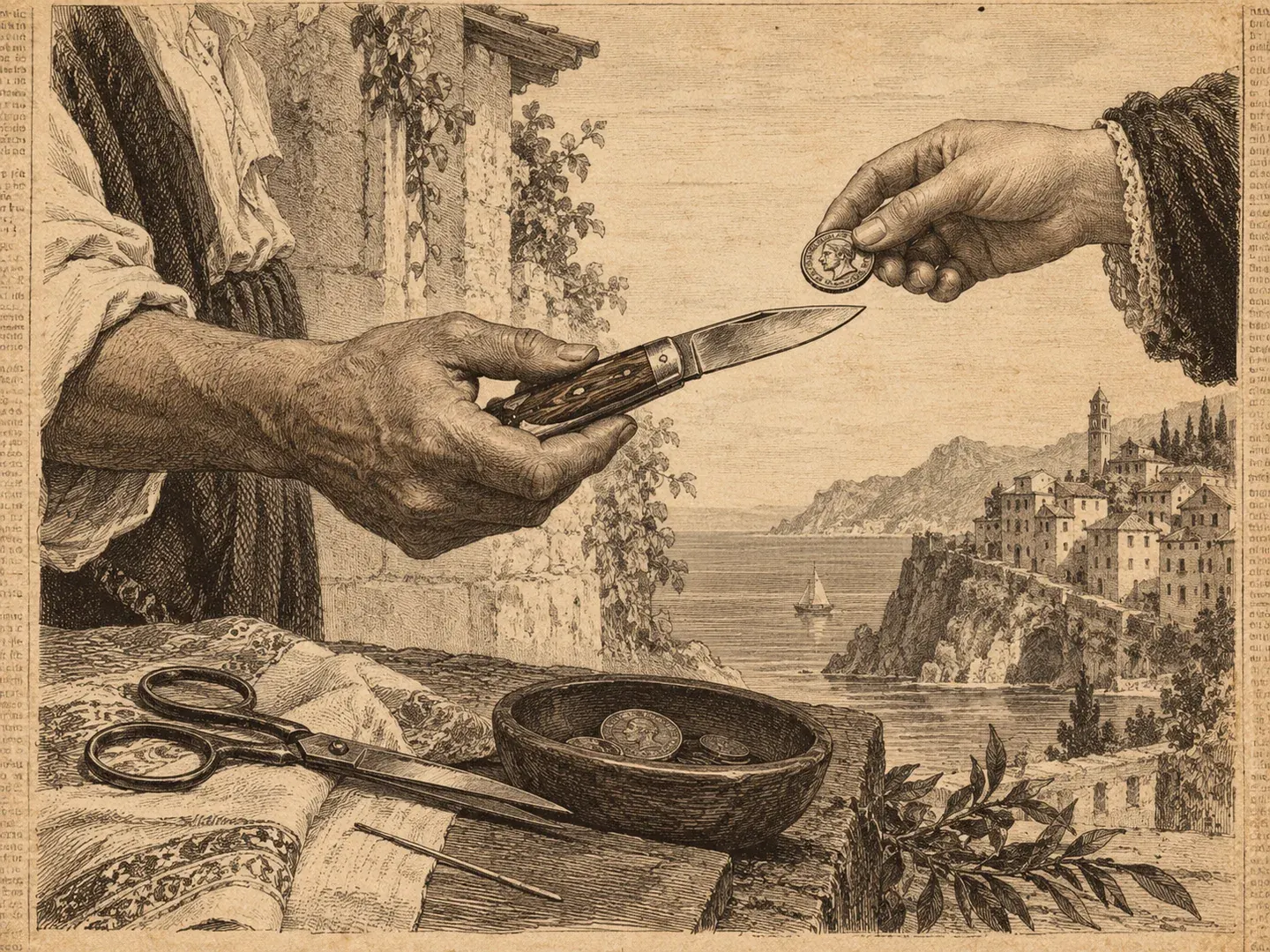
You just offered a beautiful handcrafted Corsican knife. You chose it carefully, you admired its blade, its handle, its finishes. You have dedicated a respectable budget to this.
The person opens his gift, thanks you warmly, then searches in his pocket.
She's getting a piece out of it.
A penny.
You just offered her a knife for hundreds of euros and she gives you a penny.
Commercial transactions have been more advantageous.
But be careful! This little gesture is nothing like a joke.
According to a superstition still known today, offering a knife without receiving a coin in return might cut off the friendship between the giver and the recipient.
And this history, particularly present in the Italian popular traditions, also brings us back to the centuries-old relations between Corsica and the peninsula.
Because the knife is not the only suspicious object.
In popular beliefs, scissors, needles and pins can also become real dangers to human relationships.
In Italy, we don't joke with the knives offered!
In Italy, superstition is sufficiently well known to appear in contemporary publications devoted to customs and traditions.
Not so regalano coltelli!
We don't offer knives!
Well, not quite.
One can perfectly offer one, provided that the person who receives it gives a small coin in exchange.
Why?
Because a knife cuts.
And that a blade offered could symbolically cut off the bonds of friendship, love or affection between two people.
The Italian press, in particular the Corriere della Sera, still recalls this custom and its remedy: a simple little currency given to the donor.
A penny is enough.
So that's how one can, it seems, preserve a friendship for cheaper than a coffee.
The idea seems absurd, but it is nonetheless interesting.
Because behind this almost derisory gesture is a very old way of thinking objects, their functions and their symbolic power.
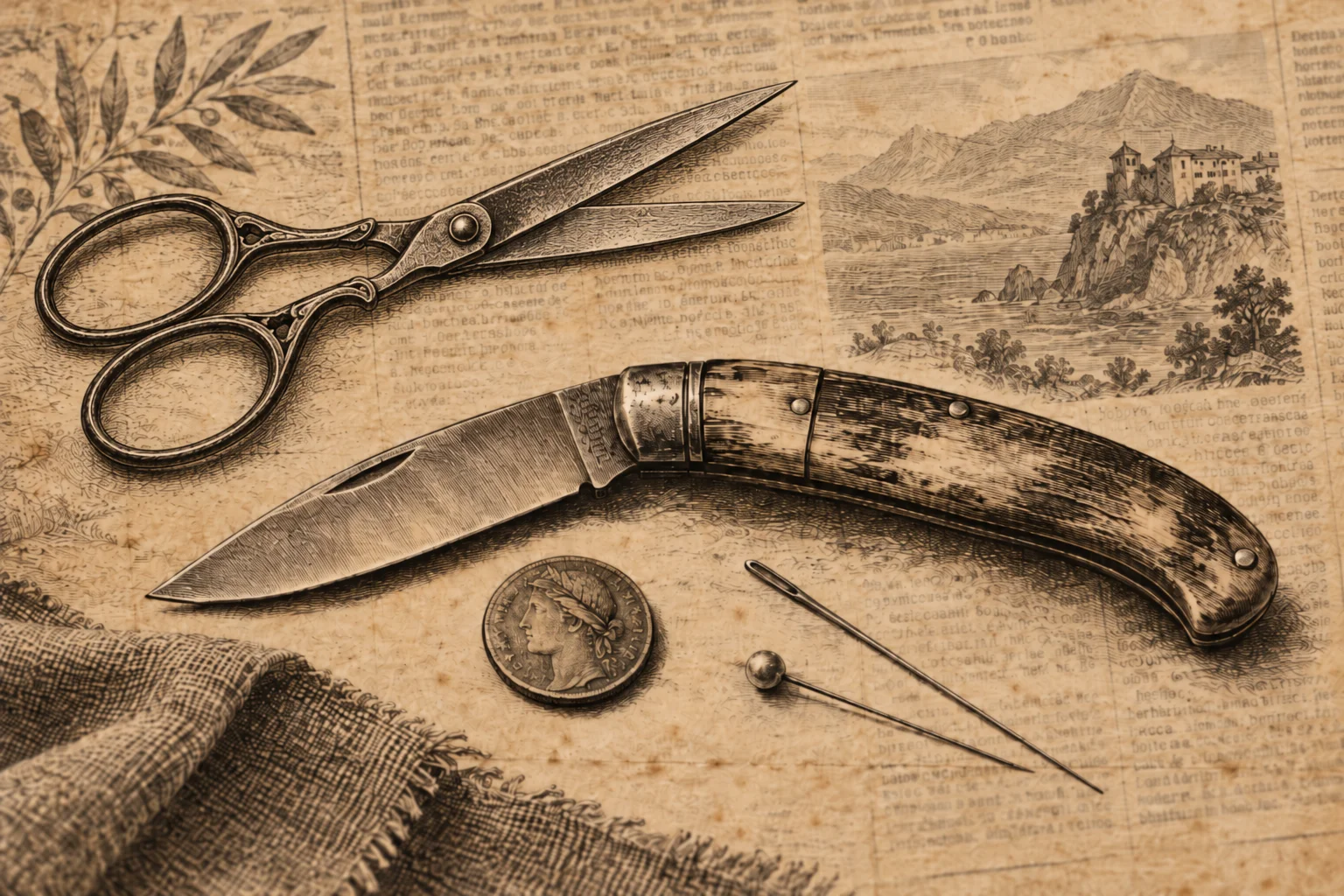
A coin, and the gift becomes a sale!
The parade is of remarkable ingenuity.
If you give a knife, you might cut off the friendship.
But if the person gives you a piece in return, the object is no longer considered a gift.
It becomes a symbolic sale.
And since it's no longer a gift, the supposed curse disappears.
The reasoning would make a lawyer smile, but he obviously satisfied the superstition.
The value of the coin doesn't matter. What matters is the gesture.
The French knifemaker Opinel also recalls this practice, which remains for some a mark of politeness or a family ritual.
You don't necessarily believe it.
We do it because we've always seen him do it.
And then, after all, why cause the bad fate when it's enough to pull out a penny?
Scissors, needles, pins: all the mercery is concerned!
One might imagine that this superstition is reserved for knives.
It would be too simple.
In Italy, scissors and pins are also considered unlucky when offered. Needles also appear in the variants of this family of beliefs.
The logic remains the same.
What cuts could break a relationship.
What stings could hurt her.
Thus, according to tradition, some precautions should also be taken when offering scissors, pins or needles.
And what about the nanny pins?
They naturally belong to this family of pointed objects, even if the precise ritual of the coin is not documented in the same way for each of these categories.
The knitting needles also have their own superstitions: in some traditions, they are not recommended to pass them directly from hand to hand, otherwise they are symbolically harmful to friendship.
At this rate, offering a sewing box could compromise years of good family relations.
Fortunately, popular beliefs have generally provided a solution.
A few cents, a symbolic gesture or another small precaution, according to local customs.
A belief that goes far beyond Italy
This superstition is not exclusively Italian.
The folk archives of the University of Detroit Mercy in the United States contain several testimonies collected in the 20th century concerning knives, scissors and pins.
There is the same idea: to offer a sharp or sharp object could break a friendship, while a given piece in exchange would avoid this misfortune.
A testimony goes so far as to evoke two hundred for a pair of scissors.
Two blades, two cents. To each one his price!
These archives show that belief has circulated in several cultural contexts.
However, they do not permit the identification of the place of birth or the reconstitution of all stages of its transmission.
And that is precisely what makes the Corsican question interesting.
Corsica and Italy: a history of several millennia
To understand why a superstition known in Italy can also find an echo in Corsica, one must look on the other side of the Tyrrhenian Sea.
And above all, remember that relations between Corsica and the Italian peninsula do not start with modern boats.
They date back to ancient times.
Corsica belongs to the Roman world for centuries. Later, relations with the peninsula continued in different forms.
From the Middle Ages onwards, the Pisane influence profoundly marked a part of the island's religious, cultural and linguistic history.
Then comes the long Genoese period, which continues until the eighteenth century.
The archives held in Pisa show continued relations between Corsica and Tuscany. Work on the Corsican language also shows the depth of these historical links.
They were not just governments or territories.
The exchanges also concerned goods, social practices, languages and daily habits.
In such a context, it is perfectly conceivable that popular beliefs have also circulated between the two shores.
After all, men traveled with their objects, customs and superstitions.
Why would they leave the latter at the port?
What if this superstition goes back to the Romans?
The question is tempting.
A widely known belief in Italy, also present elsewhere in Europe, a Corsica deeply linked to the history of the peninsula... It would be easy to conclude that it comes directly from the Romans.
But history is not built on a mere resemblance.
The researchers have actually documented the use of currencies as amulets or protective objects in the Roman world.
The pieces were therefore not only for purchase or sale. Some could receive symbolic significance.
That's an interesting fact.
However, the existence of protective currencies in ancient times does not prove that the Romans were already giving a coin when they received a knife.
No ancient text identified in the sources consulted directly attests to this ritual.
The hypothesis of a Roman origin therefore remains possible, but not demonstrated.
The custom could also spread or change in a later era.
And it would be a shame to replace a fun superstition with a invented historical certainty.
An Italian tradition that has also become a Corsican habit?
The centuries of proximity between Corsica and the Italian peninsula constitute a particularly favourable context for the transmission of popular uses.
It would therefore be unsurprising to find similar beliefs on both sides of the Tyrrhenian Sea.
But we have to distinguish two things.
On the one hand, we have testimonies documenting superstition in Italy and other countries.
On the other hand, the exact origin and chronology of its transmission in Corsica remains to be established by local ethnographic sources.
The presence of a custom in several regions is not sufficient to prove that it has passed in one direction.
In fact, Corsica has never lived cut off from the rest of the Mediterranean. Its history is made up of relationships, circulations and various influences.
It is in this shared history that the Italian track takes all its interest.
Not as a certain origin that one could date, but as a solid cultural and historical context in which this belief has been able to circulate.
So, do we have to give a room when we get a Corsican knife?
You don't have to.
A folding corse knife, a fixed knife or a craft piece will not change in quality or character because a small coin will have been handed over to its donor.
But when this practice belongs to the habits of a family, it can retain symbolic value.
The coin represents less of a payment than a gesture of precaution, complicity or respect for a given belief.
We can smile at superstition without contempt for those who perpetuate it.
It is also the wealth of these small uses: they sometimes tell more about human relations than about the objects themselves.
One last tip...
The next time you offer a knife, a beautiful handcrafted Corsican knife for example, don't be surprised if its new owner gives you a piece.
And if you offer him a pair of scissors, you may want to have some change.
As for needles and pins, find out about the person's habits.
You never know.
After all, if a piece is enough to preserve a friendship, the investment remains reasonable.
But if your friendship ends up breaking, there is no need to accuse the knife.
There is much to bet that the problem was elsewhere than in the blade.