The handcrafted Corsican knife says "modern"
Evolution of the Corsican knife
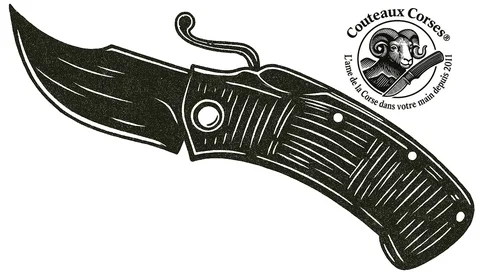
Over the past 20 years, the Corsican knife has undergone a real modernization. knifemakers It has been enriched with new mechanisms: Piedmontese, blade lock, back lock, or the liner-lock and frame-lock systems. The shapes evolve, the materials diversify, and the modern Corsican knife is now available in blades Sandvik, carbon, or Damascus In contrast, the blades Total stainless steel are, in the vast majority of cases, imported.
The system at the Piedmontese
This mechanism is based on a simple and ingenious principle. The blade has a rearward growth called lens or magnifying glass. This one comes to rest against the back of the handle when we open the blade. Maintaining the lens with the thumb increases tension and prevents the blade from closing accidentally. This system also allows a one-hand opening while maintaining excellent reliability.
The shutdown screen
The stop-cran knife is equipped with a locking device that keeps the blade open, and sometimes even in a closed position. This mechanism offers a secure use, particularly appreciated for its stability.
The system to back lock
This system allows the blocking and unlocking of the blade thanks to a metal rod inserted between the liners, which comes to lock the heel of the blade. Unlocking is done by operating a spring located on the back of the knife. Two types of pumps are distinguished:
The front pump, located near the axis,
The rear pump, located at the bottom of the handle.
Liner-lock and frame-lock
The liner-lock rests on a cut liner as a spring. When opening, this liner is positioned against the heel of the blade to block it. To close the knife, just push the liner with the thumb.
The frame-lock (or integral lock) works in a similar way, but here, it is the handle itself — not an inner liner — which ensures the locking of the blade. This system is known to offer better robustness.
Note: Sometimes it can be difficult to distinguish a liner-lock from a frame-lock, especially when it is covered with a decorative plate.
Thus, the contemporary Corsican knife combines tradition and innovation, adapting to modern expectations while maintaining its identity.
In conclusion
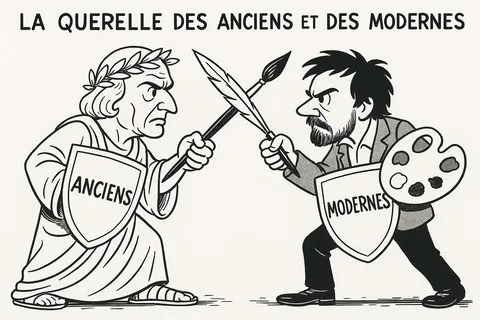
Today, in the world of the Corsican cutlery, we are at a turning point that could be compared to the famous Querelle of the Ancients and Moderns. This debate, as old as the trades themselves, goes through all fields: art, language, medicine, gastronomy... and of course, handicrafts.
Let us take a linguistic example: for centuries, Latin has been considered the only language worthy of transmitting knowledge, feelings, and memory of ancient civilizations. It was said that no modern language could match its precision, beauty or symbolic power. However, Latin has gradually been erased, replaced by vernacular languages, more lively, more accessible, and better adapted to contemporary realities. Far from losing in depth, thought has found other forms of expression. Latin ceased to evolve — and eventually died.
In art, we saw the same resistance. When the Impressionists — Monet, Degas, Renoir — exhibited their first works, classical criticism violently rejected them. They were treated as provocateurs without talent, obsessed with money, unable to comply with academic rules. Yet it was they who opened the way to artistic modernity, to the freedom to create outside dogmas. Thanks to them, art freed itself from its carcans, giving rise to movements as diverse as Fauvism, Cubism or Expressionism.
We find this tension in the kitchen: once frozen in its traditions, it was seen transformed by chefs like Paul Bocuse or Ferran Adrià, who dared to shake the ancestral recipes. Their approach initially led to the rejection of purists, before becoming an international reference.
And in the medical field? Same fight. Scientific advances have often been hampered by institutional conservatism. The example of asepsy in the 19th century is striking: long rejected by doctors attached to old practices, it ended up imposing itself as an indispensable foundation of modern surgery.
In Corsican cutlery, the question is the same: should we stay frozen in traditional forms and techniques, or can we make them evolve? Some modern artisans incorporate new materials (Damascus steel, titanium, composites) or adopt innovative mechanisms such as liner-lock or back lock. They create models inspired by the classic Corsican knife, but adapted to contemporary uses and expectations.
Faced with them, intransigent defenders of tradition claim that the "real" Corsican knife can only be that of their ancestors: handle in horn, blade crafted, “à clou” assembly, without modern mechanism. They fear that evolution will lead to a form of denaturation — even folklorization.
But it is to forget that the very essence of an art or know-how is its ability to evolve without betraying its foundations. It is not a question of erasing the legacy of the ancients, but of preserving their essential values while keeping them in the present.
True modernity does not deny the past — it is an active heir. It allows a tradition to remain alive, relevant, and transmitted.
As always in history, the Ancients and the Moderns will continue to oppose. But in the end, it is the public, the use, and the time that will cut. And it must be noted that in general, it is the Moderns who advance the world.