the handmade Corsican knife known as "à clou" or capucine assembly: U Curnicciolu
the knife known as "à clou" explained
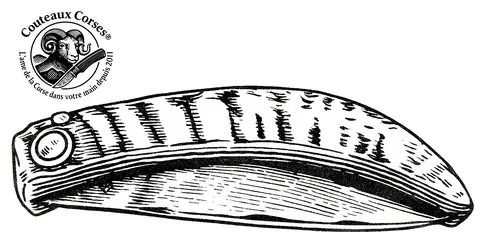
the handmade Corsican knife known as "à clou" belongs to the large family of knives of the same name. Its mechanism is based on a simple principle: an axis — formerly a simple nail — riveted on either side of the handle with two brass rosettes, allows the blade to pivot. A second nail, driven into the handle, acts as a stop for the heel of the blade.
the Curnichjolu, also known by the spelling “curnicciolu,” is the traditional Corsican folding knife with a horn handle.
In case of play in the opening or closing, a few light taps with a hammer on the axis are enough to tighten the fit. This system, both rudimentary and effective, remains one of the favorites among pocket knife enthusiasts, despite numerous technical developments in blade assembly. Although nails have been replaced by more modern and reliable axes, the name “à clou” persists, in homage to this traditional know-how that has proven itself. Its robustness and simplicity make it a model still appreciated today.
This is a system referred to as “friction.” The retention of the blade in the open position relies on no spring or complex mechanism, but solely on the friction between the blade and the handle plates — whether it is monoblock or not. The main nail serves as a pivot axis, while a second nail, positioned lower, acts as a stop by absorbing the pressure exerted on the blade during cutting, thus protecting the handle from premature wear.
The word “nail” should be understood here in its old sense: a metal peg riveted at its ends, serving either as a pivot axis (axis nail) or as a stop (stop nail).
Historically, this type of knife is one of the oldest that exists. The Romans were already using it over two thousand years ago. Without spring or sophisticated mechanism, it constitutes a true monument of cutlery. As early as the 2nd and 3rd centuries AD, the first models of folding knives appeared. Some even formed part of the basic equipment of Roman soldiers.
Under the term culter, different types of iron-bladed knives were then designated, each intended for a specific use. For example, culter coquinarius referred to a large kitchen knife, while cultellus referred to a smaller utility knife.
Corsica, having become a Roman province as early as 229 BC, was very likely one of the first European territories to see the emergence of “regional” folding knives. A thousand-year legacy that is still perpetuated today by the Corsican knife à clou.