The handcrafted Corsican knife and its history.
Corsica is an agropastoral island. The Corsican knife, an indispensable tool of this agropastoralism!
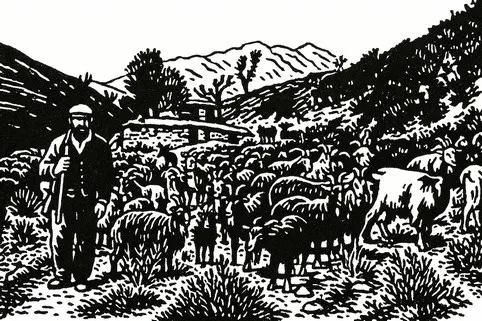
In a society such as Corsica, where agropastoralism constituted the main activity until the end of the 19th century, the knife occupied an essential, almost royal place. Each islander, male or female, had one. A true tool of everyday life, the knife was also a faithful companion to those who worked the earth or occupied herds.
At that time, the Corsican knife most often took the shape of a locally made canif. In the best case, he was leaving the workshop of the village blacksmith, but he was much more frequently shaped by his own user, with the means available. Old used tools, house fittings in ruins, wood falls or horns of dead or slaughtered animals for the needs of the family: everything was used to create blades and handles, without aesthetic concern.
The only qualities required of such a knife were its robustness and the edge of its blade. Nothing more.
Can we talk about a Corsican knife?
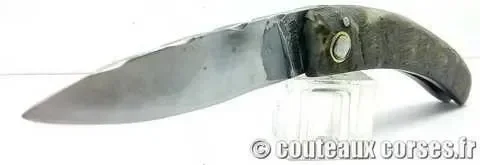
Yes and no. It is true that there is a more widespread form of knife than others, often called "Curnicciolu"*, which literally means "small horn". This name comes from the fact that the horn was, very often, the preferred material for the manufacture of handles. Abundant and easily accessible in all regions of the island, the horn was naturally used to dress all types of blades.
* The Curnichjolu, also known as the curnicciolu, is the traditional Corsican folding knife to handle in horn
Wood, on the other hand, was used more rarely. It required drying time before working, and its shaping required a specific tooling which the shepherd or farmer did not always have. Thus, the majority of the handles knives were cut from the recovered tip or body of horns.
Over time, the term "Curnicciolu" has entered into the common language to refer to what is now called the "shepherd knife". But it would be incorrect to believe that it was only for shepherds. Every man in the country had one, which he kept permanently on him: an indispensable tool for work as at the time of the snack.
Finally, it should be noted that even if the use of these knives remained the same, their shapes could vary depending on the micro-regions of Corsica and the functions for which they were intended.
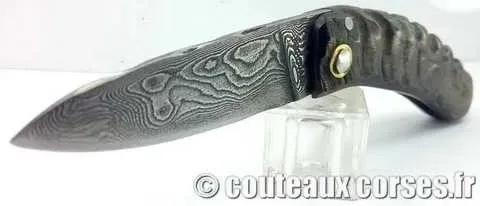
bellied, forged in one piece, with a handle made of horn or made of wood, decorated with filework or not...
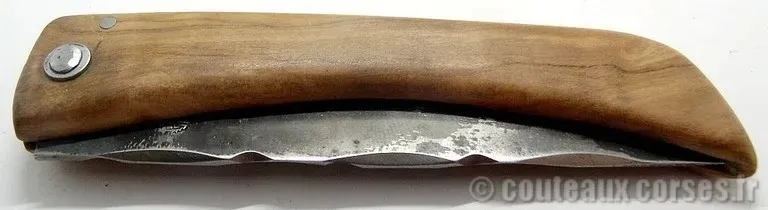
bellied, forged with a single piece, with a handle made of horn or made of wood, decorated with filework or not, whether or not fitted with a blade return, curved or straight... each knife has its own specificity. It must be perfectly adapted to the purpose for which it is intended.
Fine and straight blades were used to bleed pigs, game or other domestic animals. The more rounded blades, called "bellied", were better suited to the animal's skinning. The recurved blades were used, depending on the region, to manufacture sporte, fatoghje or other mountain basketry items, or to repair fishing nets in coastal areas.
The guilloches, contrary to what one might think, were not intended to beautify the knife. They had a utilitarian function: depending on their shape, depth or relief, they were used to scratch the grafts, to scoop the fish or even to slightly trim the wood, in the manner of mini-limes.
It is important to point out that all this concerns the Corsican knife before the industrial era: an artisanal knife, shaped by hand. As from the years 1900, a "other Corsican knife" makes its appearance: the imported industrial knife, quite different in its design as in its use.
The post-industrial Corsican knife
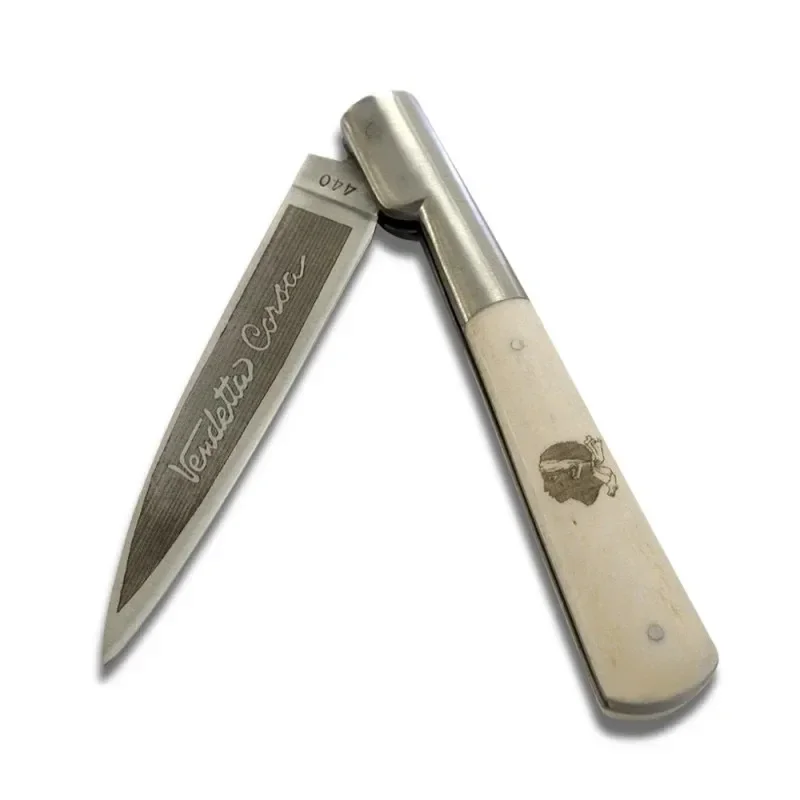
Between the beginning of the industrial era and the movement of ri acquistu, a multitude of so-called "corse knives", often fanciful, emerged and invaded local and national markets. These objects have largely contributed to freezing in the collective imagination the image of a violent and revengeful Corsica, as described by Prosper Mérimée in Colomba or Matteo Falcone. The word was spoken: Vendetta... And with him, appeared a new category of knives, stamped "Corses", but of doubtful origin.
Some wore a Moorish head, others with avenging accents, often written in Italian. However, these knives had no corse but the name they were given and the supposed origin that their manufacturers attributed to them. In fact, they were most often made on the continent, by renowned knifemakers. Of course, these industrial productions offered strength and sharpness, but they remained far removed from the spirit of the handcrafted Corsican knife.
Still today, some knifemakers of the continent, yet well established, feed massively the tourist shops of the island – and elsewhere – with "Corses knives" produced in series. In most cases, these items are subcontracted to Asian plants, with a low-quality steel whose limits are no longer to be demonstrated.
It is important to remember that a Corsican knife does not consist of a Moorish head engraved on the blade or a regional coat of arms. A real Corsican knife is designed and forged by a local craftsman, with quality materials, with respect for traditions and authentic know-how.
But again, vigilance is required. The crackdown on fraud has recently forced some pseudo-knifemakers, active only in the tourist season, to replace the mention "Made in Corsica" with "Assembled in Corsica" on their displays. A nuance of size... but which seems to pose no problem of conscience to those concerned.
Finally, know that very few real island knifemakers write avenger messages on their blades, affix sloppy decorations or engrave Moorish heads with caricatural features. Quality, sobriety and authenticity remain the true marks of the handcrafted Corsican knife.
The Riaquistu or the era of re-appropriation
About 30 years ago, in the 70 years, the Corsican knifemakers took the decision to re-approve their legacy by denouncing, on the one hand, the numerous fakes and counterfeits circulating under the label of "Corsian knife", and on the other hand, by relaunching an authentic and ambitious artisanal production. Their objective: to make their work known, to enhance the real Corsican knife, and thus to compete with the industrial imitations that have invaded tourist shops and even the so-called "craft" markets.
This competition is not about quantity, but about quality. Aware that the real know-how was now on their shoulders, these artisans refused to give up. With passion, pride and love for their profession, they have reborn the Corsican knife in its most noble and faithful form to its origins.
Each according to its style, each island knifemaker has helped to revive the deep attachment that Corsicans have to this everyday object. For in Corsica, a knife is not a simple tool: it is part of life, identity, traditions. In the past, he even marked a real rite of passage. At the age of 10, a boy received his first knife – a highly symbolic gesture. This gift meant that he was no longer regarded as a child, but as an active member of the family, ready to assist in field work and breeding. The knife thus marked its entry into the adult world.
By relaunching the production of the Corsican knife, the island knifemakers brought life not only to the object itself, but also to the rites and values it carries.
Some will say that today, a real Corsican knife is not within the reach of all scholarships, that it has become a luxury object more than a tool. To this, it must be said that an artisanal knife is not made by the chain. It requires hours of careful work, material selection, assembly and finishing. And above all, it is designed to last, to be transmitted, as a real object of heritage.
Each knife is covered by a lifetime warranty, unique, signed by the hand of its artisan – a guarantee of authenticity and quality. The knifemakers corses are both creators and guardians of tradition. Their production embodies both innovation and memory, creativity and fidelity to history. They offer lovers of beautiful blades of the unique pieces, equipped with a soul, character and true presence.
This is why it is better to wait a little to acquire – or to offer – a real piece of island cutlery, rather than to give in to the temptation of an industrial assembly without a soul, which has come from no one knows where.