A glossary of the Corsican knife and knives in general …
The types of steel used
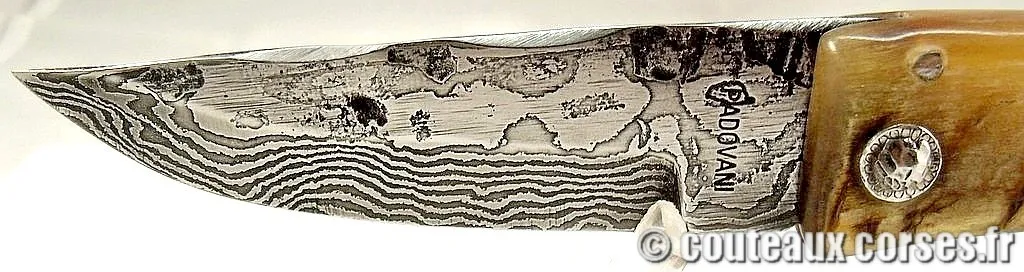
We'll offer you 4 types of steels: the carbon steel which will most often be described under the simple term of carbon example " Length of the blade Carbon XC75 poli: 9.5 cm Three types of carbon steel make up the blades on sale on the website Knives-corses.fr: le XC75, 90MCV8 and 15 N 20.
The XC75 it is easy to sharpen and holds the cut well. Its hardness is of high quality. 48 to 52 HRC on the Rockwell scale after soaking.
The 15 N 20 offers good wear resistance and high elasticity. It is generally used in the manufacture of Damascus because it contains nickel. Its sharpness and cut are remarkable and its sharpening easy. Its hardness to go up to 65 HRC on the Rockwell scale
The 90MCV8 resists shock and wear is determined by hardness (57 to 62 HRC on the Rockwell scale)
The fourth steel is the steel 14c28qui is a stainless steel. The steel 14C28 is a stainless chromed steel, optimized for the cutlery. After heat treatment, its carbon and chromium composition brings it a unique combination of properties: very high hardness index (near 59 HRC on the Rockwell scale), good corrosion resistance, very good wear resistance.
The Damascus present on this site is usually composed of two or three steels carbons the XC75, the 90MCV8 and the 15N20.
The heat treatment process
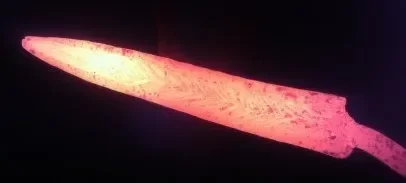
Thermal treatment
Thermal treatment usually consists of two major steps: quenching and tempering.
The blade Trempe: quenching is the first part of the heat treatment which consists of heating a steel piece at a certain temperature (variable according to the types of steel) and cooling it abruptly by immersion in a fluid (water, oil, salt bath) or air, so that a molecular reaction can occur so that a hard structure called martensitic can be obtained.
The yield: is the second part of the heat treatment which consists of reheating the previously soaked part at a temperature lower than that of quenching (variable according to the types of steel). The income eliminates the fragility of the steel and makes it more resistant while allowing to adjust the desired hardness (expressed in Rockwell) for the steel part.
The Annealing The annealing is an operation which consists of heating a piece of steel for a certain time and then cooling it very slowly. The annealing softens the metal, removes internal tensions and stresses and improves usability. The annealing is used to "ramollir" a piece of steel that would have already been soaked and that we would like to rework.
The blade grind of a knife
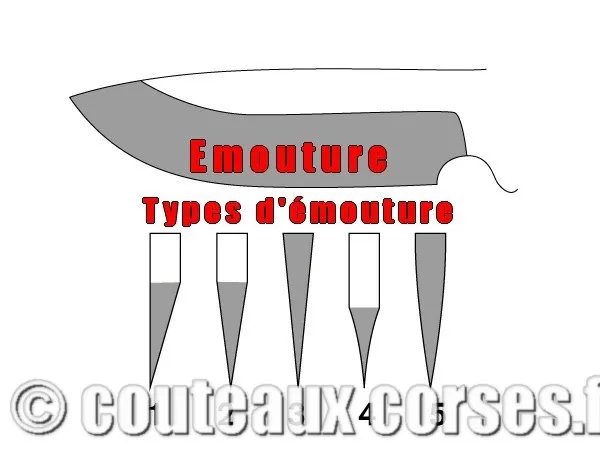
The blade grind refers to both the part of the blade that is amincite to form the blade wire as well as the way in which the blade is amincite.
Several types of blade grinds are distinguished:
1 -Scissor or asymmetric movement: commonly used on kitchen knives and especially on Japanese knives.
2 - Partial flat movement: the bevel does not go up to the back of the bevel blade
3 - Total flat movement: the bevel climbs up to the back of the blade. The advantage of this type of blade grind It is a strong and powerful edge. We will find this form of blade grind on many forged knives.
4 -Deep mooring: We will usually find the blade grind hollow on knives to blade flexible as well as the boners.
5 -Strengthed movement: The advantage of this type of blade grind is the lifespan of its edge.
The decorative filework
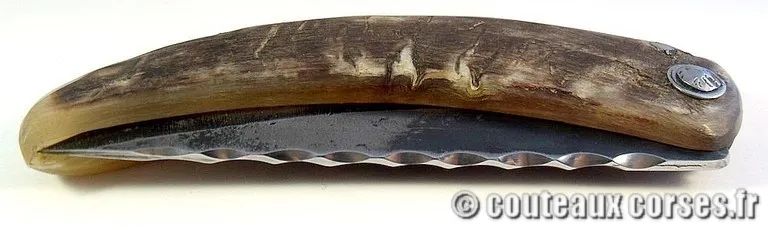
The decorative filework is a technique of decoration of blades and springs by removing material from the lime or burin of hollow patterns.
Customize your Corsican knife
