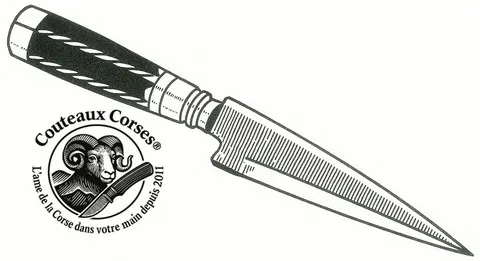
The Corsican stiletto and its history
And what about the Corsican stiletto?
The stiletto, so often depicted in 19th-century literature as a symbol of vengeance and violence, appears notably in La Vendetta by Honoré de Balzac (1830), Colomba by Prosper Mérimée (published in 1840 in the Revue des deux Mondes and then in volume in 1841), or Une vendetta by Guy de Maupassant (1884). In these narratives, it is presented as the emblematic weapon of the Corsican vendetta, bearer of disgrace and violated honor.
However, originally, the stiletto is nothing more than a hunting dagger, forged from a single piece, intended to finish off the wild boar or the island deer. It was a functional and effective tool, far removed from the dramatic image that fiction has given it.
Subsequently, the stiletto became the standard weapon of the Corsican soldier, before being adopted, around the turn of the 1800s, as a personal defense weapon accessible to all. By 1900, it took on a more folkloric dimension: it was willingly worn when dressing "in the Corsican way" or to imitate the mythologized figures of honorable bandits.
It is important to note that there are two distinct types of stilettos in Corsica:
The single-edged Genoese-style stiletto,
And the double-edged Corsican stiletto, which appears to have been used earlier on the island.
Thus, long before being a literary or folk symbol, the stiletto was a hunting tool, a functional object anchored in the island daily.
The Corsican stiletto: a heavily romanticised history
It is important to remember, first of all, that the stiletto — whether corse or not — is an estoc weapon, intended to kill rather than cut. In Corsica, before the 16th century, the stiletto was just a hunting tool, forged in one piece, used to shoot down the boar or the island deer.
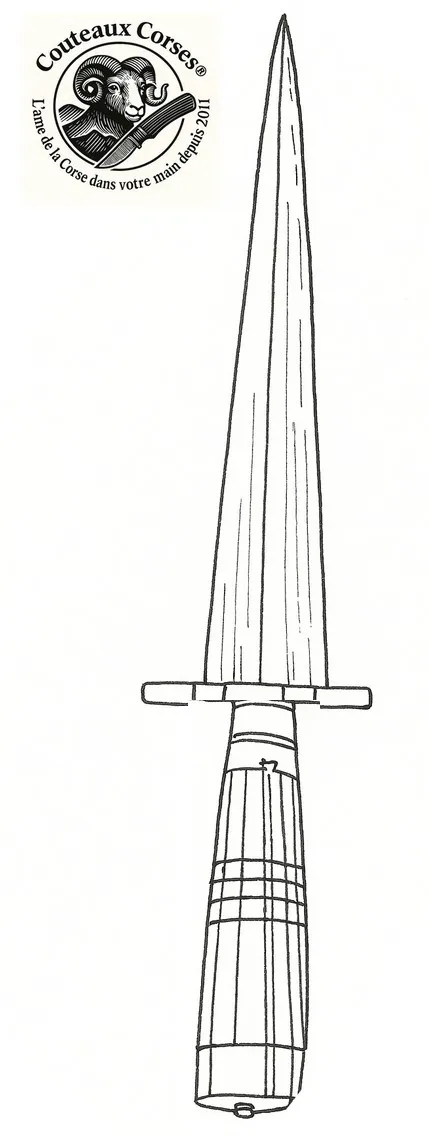
It was at the beginning of the 16th century that it appeared in its present form, both in its version called "to the corse" and "to the genoise". The first, double-edged, is distinguished from the second, single-edged — even if in both cases the expression "edged" is in fact inappropriate, the first use remaining the perforation, not the cutting.
The blade, forged by a process similar to that of the four-sided frame nails, has a median section on which two bevels are drawn or, in other cases, a single slope on each side forming an angle of approximately 30°. The rest — guard, tang, handle — varies in size and style according to the inspiration or "matte" of each blacksmith.
Historically, the stiletto is the weapon of the Corsican infantryman, whether he is a mercenary or a regular soldier. He was assigned as an integral part of his equipment. Initially double-edged, it will evolve towards the form "to the genoise" during the conflicts against Genoa, then against France. Subsequently, the stiletto will become the single defence weapon par excellence, worn daily by both men and women. In the troubled times that Corsica passed, he was considered a true companion of survival. Note that the stilettos worn by women were generally smaller in size.
In the 19th century, the stiletto was elevated to the rank of literary symbol, particularly in French romantic literature. It becomes the emblematic instrument of the vendetta, bearer of misfortune and fatality. It can be found in several major works of the time:
La Vendetta by Honoré de Balzac (1830)
Colomba of Prosper Mérimée (published in 1840 in the Revue des Deux Mondes, then in volume in 1841 )
Les Frères corses by Alexandre Dumas (1845)
Une vendetta by Guy de Maupassant (1884)
It is true that during the 18th and 19th centuries the stiletto was frequently used by corse "honour bandits" in rixes or settlement of accounts, thus strengthening its reputation as a cursed weapon. Whether or not it has been demonized, the stiletto remains a highly valued cutlery piece in Corsica. Each family had at least one, often passed on from generation to generation.
In the late 19th and early 20th centuries, the stiletto even incorporates traditional outfits, becoming an object of appearance. It is then adorned with elaborate decorations, reflecting the social status of its owner — in short, one of the very first bling-bling objects of Corsican society.
Notable fact: it is from this famous stiletto Corsican, in its genoese version, that the knifemakers of Thiers, in the 19th century, will design the famous Vendetta. Inspired by romantic literary fashion, they had the idea of making it a folding knife, easy to carry, and decorating it with revengeous maxims engraved in corso-Italian idiom, promising death to the enemy.
Irony of the spell: it is from the most authentic of the Corsican knives that was born... the least corse of all.