In Corsica, the cutlery is not just a matter of blades, handles or mechanisms. It belongs to an artisanal history deeply linked to the people, uses and resources of the island. A legacy that, far from enclosing the knifemakers in the reproduction of old models, allows them today to imagine original, demanding and resolutely contemporary pieces.
A utilitarian object become an expression of Corsican identity
Before being a collection object or a piece of cutlery art, the knife was a tool of everyday life.
In Corsican agropastoral society, he accompanied shepherds, farmers and, more broadly, all those who needed a simple, solid and functional instrument.
The shapes, dimensions and materials were first of all practical requirements. The knife was to be cut, transported easily, maintained and served in a durable manner.
This origin explains part of the character of the island cutlery: a certain sobriety, attention to use and a direct relationship between the shape of the object and its function.
But speaking of the traditional Corsican knife in singular would be reducing. The history of the island is not limited to a single, immutable and universally adopted model.
It is precisely this diversity that today constitutes one of the riches of the craftsmanship knifemaker Corsica.
Tradition does not prohibit originality
An artisanal knife is not only defined by its appearance.
It also carries the choices of the one who designed and realized it: the drawing of its blade, the balance of its proportions, the selection of materials, the type of assembly and the finishes.
Some artisan knifemakers prefer ancient forms, seeking fidelity to past uses and silhouettes.
Others explore new lines, develop different mechanisms or combine contemporary materials with traditional references.
These approaches are not necessarily opposed.
Observing a tradition does not mean giving up creating.
The cutlery Corsican can evolve without losing its identity, provided that it does not confuse a creation actually produced by the work of an island craftsman with an industrial manufacture simply decorated with Corsican symbols.
Authenticity is not a matter of engraving or commercial argument. It relies primarily on identifiable origin, real work and know-how.
The quality of materials, a technical as well as aesthetic choice
The choice of materials is an essential step in the design of a knife.
A beautiful blade is not enough. Still, its steel must match the desired use, the handle must be hand-adapted and the whole must have a satisfactory balance.
steels: properties to understand
knifemakers uses different steels depending on their work habits, techniques and expected characteristics.
The carbon steels are particularly appreciated for their cutting qualities and their suitability for the sharpening. However, they require special attention to moisture and oxidation.
The steels stainless steels offer, depending on their composition and thermal treatment, better corrosion resistance. However, they are not all the same in terms of edge hold, hardness or ease of maintenance.
Therefore, there is no steel that is universally superior to others.
A quality steel is above all a correctly chosen, processed and implemented steel for the intended use.
The quality of the heat treatment, the geometry of the blade and the care provided to the blade grind count as much as the commercial designation of the steel.
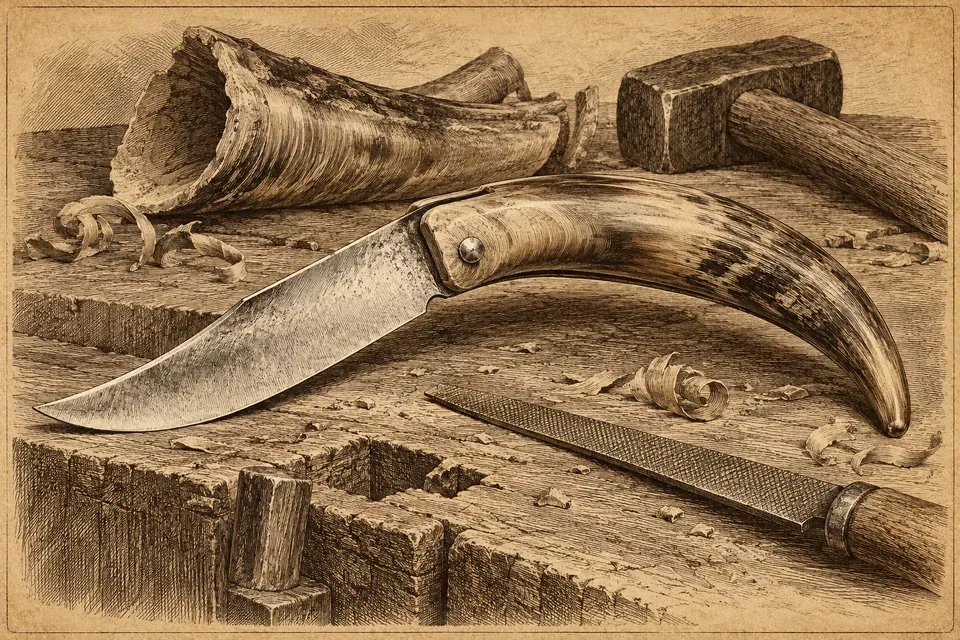
horn, wood and other materials of handle
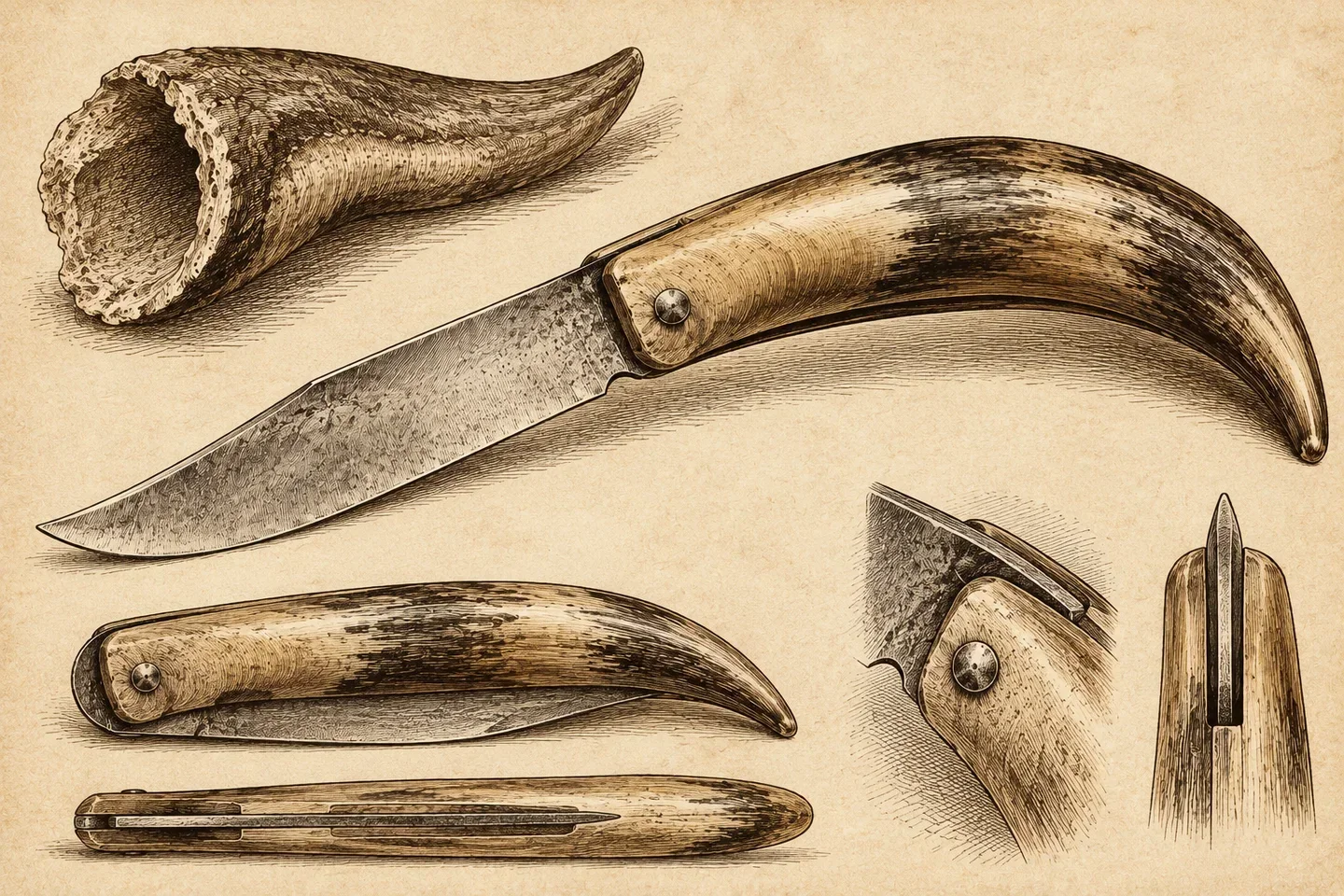
The horn occupies a special place in the history of the Corsican cutlery.
A source of sheep and goat farming, it has long been an accessible resource for the production of handles. Its use remains closely associated with some traditional models.
The curnichjiolu or curnicciolu, whose name refers to the small horn, illustrates this link between the raw material, use and identity of the object.
Today, knifemakers can also work on different wood species, natural materials or modern technical materials.
Each choice responds to aesthetic and practical considerations: resistance, stability, texture, maintenance, gripping comfort and shaping possibilities.
A handle in natural matter often has nuances and variations that contribute to the particular character of each achievement.
These differences do not necessarily constitute imperfections. They may also participate in the identity of the document.
Craft know-how makes the difference
Two similar silhouette knives may differ significantly in their design and production.
The quality of a knife is judged by all its components and their assembly.
On a folding knife, the operation of the mechanism, the adjustment of the parts, the regularity of the opening and the mastery of mechanical games deserve special attention.
On a fixed knife, the design of the blade, the strength of the mounting and the ergonomics of the handle are equally essential.
Finishes are also important. They demonstrate the care taken in manufacturing, without a spectacular finish necessarily being synonymous with better quality.
Different manufacturing methods must also be distinguished.
A forged blade is not automatically superior to a blade performed by removing material. Both processes can produce excellent knives when controlled and combined with appropriate heat treatment.
The real know-how lies in the coherence of all these operations.
From the traditional piece to contemporary creation
The richness of the island craft cutlery is also due to the variety of its achievements.
The shepherd knife, curnichjiolu or curnicciolu, contemporary folding knives, fixed models and cutlery pieces of art show different approaches.
Some knives are designed to accompany their owner in common uses. Others favour aesthetic research, a particular work of materials or a sophisticated mechanical design.
An original piece does not need to multiply ornaments to distinguish itself.
A perfectly controlled line, an unusual but balanced proportion, a particularly neat assemblage or a judiciously chosen material can be enough to give it a real personality.
Originality is therefore not a mandatory break with old models. It may arise from a personal, discreet and respectful interpretation of their principles.
It is also this freedom of creation that allows the cutlery Corsican to remain a living craft.
A beautiful object must also be a good knife
Aesthetic research must not make one of the first reasons to be the cutlery: use.
A knife can be elegant, original, made in remarkable materials and nevertheless not suitable for the use to which it is intended.
Conversely, a very sober piece can reveal an excellent design and remarkable quality of realization.
The comfort of the handle, the general balance, the cutting geometry and the ease of maintenance are decisive criteria.
The choice of a knife therefore deserves to be based on real needs.
A knife intended for regular use will not necessarily be designed according to the same priorities as a collection piece or a cutlery art creation.
Both approaches can be perfectly legitimate. The essential thing is to understand the vocation of the object.
Preserving a legacy without freezing the Corsican cutlery
An artisanal heritage is not only preserved by reproducing ancient forms.
It is also transmitted through gestures, technical knowledge, the mastery of materials and the ability of artisans to change their profession.
Contemporary Corsican knifemakers participate in this transmission when they maintain historical know-how, but also when they develop their own creations in an authentic manufacturing process.
Tradition provides landmarks. It does not necessarily impose limits on the invention.
Respect for the past and the requirement for quality can accompany modern aesthetic research.
What matters, in the end, is not that a knife looks like a preconceived idea of Corsica, but that its manufacture, its origin and its identity can be explained without artifice.
Whether it is an ancient model of inspiration, a utility knife or an original creation, each piece deserves to be appreciated for what it is: the result of technical choices, controlled gestures and an identifiable artisanal approach.
For the Corsican cutlery is not a figure or emblem.
It exists primarily by the artisans who make it live.