The knife occupies a place in the texts that often exceeds that of the object described. Its presence can announce a threat, recall a blood debt, make a conflict visible, or be sufficient to characterize the person carrying it. When it is described as a Corsican, this narrative charge requires particular attention: the weapon sometimes becomes a sign of belonging, and then membership itself is an explanation of violence.
The passages gathered here allow us to follow this construction in several French works, from the 19th century to the end of the 20th century. They do not summarize all of this literature or all of its views on Corsica. However, they reveal a recurring rapprochement between the island, its inhabitants and the white weapon. It should be examined not only the forms but also the contradictions.
A distinction must be made beforehand. A knife, a dagger and a stiletto are not interchangeable designations. The word "vendetta" can name a revenge or a knife model. The presence of the first sense in a narrative never proves that of the second. Respecting the words of the authors is the first condition for a fair reading.
1830 — Balzac: the dagger and family justice
In La Vendetta, Bartholomeo di Piombo appears from the first pages with a weapon taken from his jacket:
A long dagger
Later, his opposition to his daughter Ginev's marriage led him to grab a dagger and sway towards her, before giving up hitting her. The weapon thus accompanies the transition from paternal authority to the threat of death.
Reading can recognize a representation of the family locked in deadly fidelity to its past. The dagger makes this constraint immediately visible. It would, however, be incorrect to see the description of a knifemaker model identified: Balzac writes "dagger", not "stiletto Corsican". It is the character and his story that give the weapon its island coloration.
The title of the story refers to family revenge. It does not refer to the knife called vendetta.
1840 — Mérimée: the stiletto transformed into Romanesque curiosity
At the beginning of Colomba, Captain Ellis offers Miss Lydia:
a pretty little stiletto
Its value lies mainly in the bloody provenance attributed to it by the account. The young traveller welcomes this object in the continuation of the stories of bandits who nourish her curiosity for Corsica.
The weapon becomes the support of a desire for exoticism. What miss Lydia is looking for on the island is already contained in the present she receives: the change of scenery, the danger and the supposed proximity of exceptional violence. We can read in this scene a setting in place of the cliché, but also an irony directed against the one who wishes to meet him.
Merimée, however, gives the stiletto another thickness. In chapter VIII, the one that Colomba wishes to offer is a family antique, whose history it links to King Theodore. The symbolic payment of a penny accompanies its transmission. The object therefore also bears memory, affection and gift. Reducing these scenes to a celebration of violence would mean losing part of the text.
1840 — Flaubert on Travel: from information collected to generalization
The account of Flaubert's journey to Corsica, made in 1840 and published after his death, describes different ways of carrying the dagger. About a dinner in the prefecture, he reports:
we assured that not one of the guests was without his stiletto
These first words set out the nature of intelligence. Flaubert reports a statement received; he does not indicate that he himself checked the arming of each guest. The passage nevertheless moves the weapon out of the world of bandits alone. It accompanies the journeys, remains on its own in the city and appears up to an institutional framework.
In this presentation, the entire Corsican society seems to be able to be read through the carrying of the weapon.
This is where the testimony must be interrogated. A particular observation, an anecdote and a general formula do not have the same documentary value. Their rapprochement gives the narrative its strength, but can also transform practices in a collective nature. This critical reading does not imply denying the practices described; it asks that they not be told more than is established.
1845 — Dumas: a Corsica expected before even being met
In The Corsican Brothers, Lucien de Franchi evokes:
in the middle of the blows of stiletto, in the middle of the stab wounds
Repetition puts weapons in a conflict environment. But the character specifies that he plays an umpire role there. He works to resolve the dispute rather than to maintain it.
Dumas mainly introduced a decisive remark: his visitor would have come to look for the bandits that Mérimée had painted in Colomba. Literature thus becomes a way of waiting for the country before it becomes known. The traveller seeks to find an image already read.
This scene allows us to grasp the operation of the cliché without pretending to measure its real influence on all readers. A representation circulates between works; it becomes an expectation that the narrative can satisfy, discuss or thwart. The Corsican character is not only the one who exercises violence: he is also the one who explains to the visitor the limits of his gaze.
1877 — Daudet: from weapon to political suspicion
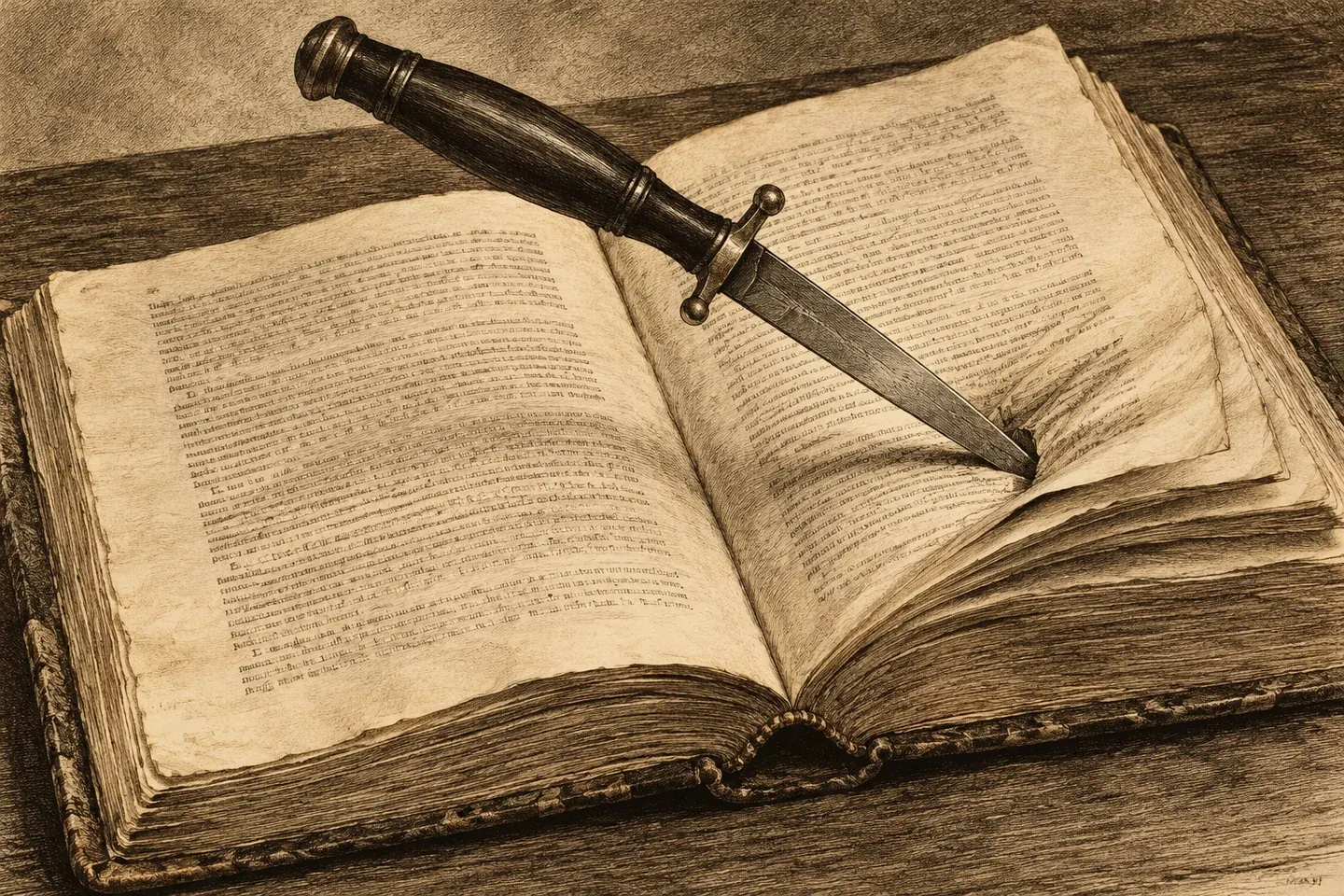
In the chapter "A Corsican Election" of the Nabab, antagonisms are expressed by men:
Squeezing the handle of their knives at the slightest contest
The weapon makes the discussion likely to tip at any time. Paganetti then explains that the anonymous letter now replaces the stiletto and the telescope.
The displacement is significant. Violence does not disappear from representation; it changes means. The knife succeeds intrigue and denunciation. The scene thus combines electoral rivalries with a continuity of hostility.
However, it is necessary to keep the distance between the explanation of a character and a historical description of Corsica. Daudet built a romantic satire. This passage can be analysed as a staging of suspicion and rivalry, without its judgments becoming truths about a population.
1883 — Maupassant: the knife behind a gear
In A vendetta, Antoine Saverini is murdered:
done a knife
His mother then organized her revenge by directing their bitch to attack the murderer. The knife triggers the story, but it is not the final instrument. It is the persistence of revenge that controls the action. Initial violence continues in the methodical preparation of another death.
Accuracy is necessary for the history of the cutlery: Maupassant here does not describe a stiletto or a folding knife named vendetta. The title refers to revenge. Using it to attest to the presence of a model knife would be confusing.
The negative image is constructed differently: a particular murder becomes the starting point of a narrative where fidelity to death seems to be only able to end in the destruction of the murderer.
1886 — Zola: the "Corse knife" as a disturbing shortcut
In L-Work, the memories of college arise:
Spontini, the fierce pawn, with his Corsican knife which he showed rusted from the blood of three cousins
The formulation concentrates the name of the object, the ferocity of the character and the family blood. The weapon does not need any additional description to produce its effect.
It would be excessive to draw a doctrine from Zola on Corsicans: the passage belongs to a gallery of school memories, grotesque and terrible. It nevertheless shows how the knife qualified as Corsican can become an accessory immediately charged with threat.
The object is identified by the blood attributed to it. Its shaping, its uses and its material history remain out of the field. For the reader, his function in the scene is to make Spontini more formidable.
1908 — Aicard: a female weapon between defense and characterisation
In Maurin des Maures, Tonia answers:
Did I not my stiletto Corsica?
Elsewhere, she checks her presence under her bosage and fate during a confrontation with Maurin. The text then describes the triangular blade.
This female presence complicates the pattern of a knife reserved for confrontation between men. The stiletto also represents the possibility of protecting and opposing resistance. It accompanies the character's desire not to be defenseless.
The association between the weapon and its Corsican membership, however, remains insistent. The risk, in reading, is to make an individual behavior the expected expression of an origin. The two dimensions should be retained: the character has an ability to act, while the story uses a highly recognizable island sign.
1913 — Bergerat: the craftsman finds a place in the story
In his memories of a 1887 stay, published in the fourth volume of the Souvenirs d'un enfant de Paris, Émile Bergerat evokes a Piedipartino armorer. He describes his work of tempering and decoration, then defends the old stiletto against productions which he considers inferior.
The object finds a manufacturer, a place and gestures. But Bergerat concludes his comparison with this formula:
They probably kill as well, but less artistically than the others
The spirit trait brings home artisanal work to lethal efficiency. Recognition of know-how is therefore not enough to free the stiletto from its usual literary use.
This passage deserves to be kept in all its tension. It documents a look at handicrafts, without constituting a definitive technical classification. It also reveals how much the weapon can remain trapped in the blood, at the very moment when the author seems to be interested in its manufacture.
1924 — Leroux: the Corsican knife in the macabre auction
In The Woman with Velvet Necklace, Gaston Leroux writes:
Safer of his good Corsican knife than of the pseudo-historical instrument that had betrayed him
The weapon intervenes in the outcome of a history of revenge in Bonifacio. The narrative, which combines terror and explanation of the prodigy, places it in the service of a mutilation.
We are in a macabre fiction, the effects of which cannot be read as a description of Corsican practices. But this Romanesque freedom does not prevent us from questioning the choice of signs: the knife is explicitly described as Corsican, and its effectiveness accompanies the horror of the scene.
The object does not receive any artisanal thickness. It serves to complete the tragedy and confirm the destructive power of revenge.
1997 — Louis Arti: the vendetta in family memory
In the 1997 edition of El Halia. The sand of El Halia, Louis Arti explicitly designates the object:
This knife is a vendetta, a typical Corsican weapon
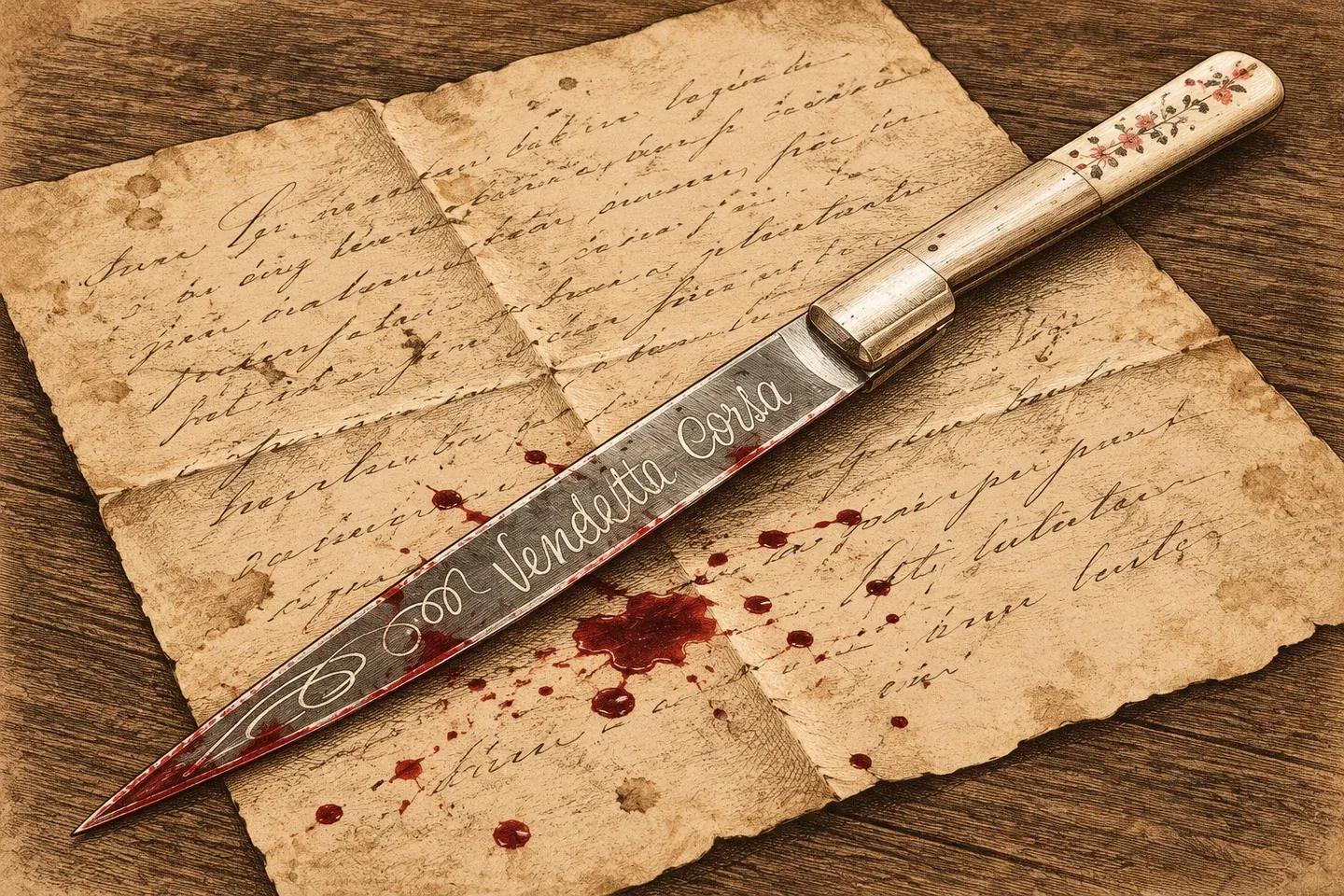
His Corsican grandmother picks up this weapon decorating the dining room after a joke that put a baby in danger. The blade carries a maxim of revenge.
The context differs from the previous accounts: the object belongs to a family memory and to a woman's reaction to the danger of a child. It would be reductive to put this scene on the same plane as Leroux's outcome.
It nevertheless shows the persistence of an association between the name of vendetta, the object exposed, the threat and the Corsican identity. The qualification used by the author belongs to this memory; it does not establish the place of manufacture of the knife.
From literary object to the image of a people
These texts do not constitute a single discourse. Their characters, intentions and processes differ. Yet they give us to observe a recurring slide: a weapon characterizes a character, then the origin of this character seems to explain the presence of the weapon. When this rapprochement is repeated, the knife can become the expected sign of a supposedly violent population.
The admiration itself does not necessarily remove this reduction. A character can be courageous, faithful, hospitable, and remain locked in a universe where his identity is only fully legible through threat or revenge. A flattering representation of honour can thus preserve a impoverished vision of men.
It is not a question of asking novelists to write inventories of cutlery. It is about reading what they put in the foreground and what they leave in the shadow. In this corpus, murder and threat occupy a considerable place; the manufacturer, matter, ordinary use and transmission are more rarely developed. When they appear, as at Mérimée or Bergerat, they allow precisely to open the reading.
Returning to the Corsican knife its history therefore demands to distinguish the real object from its Romanesque uses. Literature is a source for understanding representations. It cannot be enough to define a material heritage or the men to whom it associates it. The knife does not sum up a people. The blood that a story loads its blade cannot become an identity.